Typical Characteristics Bandwidth Gain Size Impedance Pattern Polarization 1% - 5% 6dBi 30Ω - 200Ω Unidirectional Linear The microstrip patch antenna takes on many forms and has been widely used in the past due to its low profile and ease of manufacturing. There are many different types of microstrip patch antennas, and many of them can be found in the. While this type of antenna is not used as much as it once was, the theory behind this antenna has led to many of the more modern antennas such as the IFA, PIFA, and FICA antennas. All the equations for determining the size and impedance of an inset fed patch antenna are at the end of this post. Camera Standard Vs Adobe Standard. Matlab scripts are provided.
This design approach helps analyzer microstrip inset-fed patch antennas and helps to locate the exact inset length for 50-? Input impedance. A Design Rule for Inset-fed Rectangular Microstrip Patch Antenna M A MATIN, A. SAYEED Department of Electrical Engineering and Computer Science.
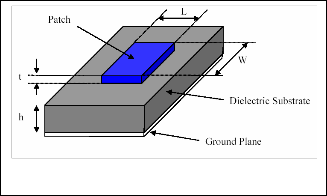
Rotate Image by clicking on the image and moving the mouse The rectangular patch is one of the more common types of patch antennas. This antenna is designed using a rectangular piece of electric conductor situated above a ground plane. The rectangular piece of copper measures long. Note that the wavelength depends on the material situated between the ground plane and the patch; meaning when air is between the patch and ground, the length of the rectangle electric conductor is of the free-space wavelength ( ). If the antenna is loaded with different dielectrics, the length of the antenna decreases as the dielectric constant increases.
The natural input impedance of a patch antenna dependent on where within the patch the feed is located. It is possible to match the patch antenna from below 30Ω to above 200Ω. If the feed is located closer to the edge of the patch the input impedance will be high, if the feed is located closer to the center of the patch the impedance will be low.
Below is the standard input impedance of an inset fed patch antenna at 2.45GHz. Typical impedance of a inset fed patch antenna There are many different ways to feed a patch antenna, the inset fed patch antenna is fed via a microstrip feed line connected to a specific point within the patch. Through varying the location of where the microstrip connects to the patch antenna the measured input impedance can be controlled.
In the reflection coefficient shown above was matched to a 50Ω microstrip line. The Microstrip patch antenna is a little different than many antennas, as the structure itself does not radiate, but rather the edge gaps between the patch and the ground plane. This can be visualized below. Line is situated directly above where the patch radiates from, this effects the pattern of the patch antenna and what applications it can be used in. The areas where the patch radiates from are shown below.
The patch antenna radiates from the side in which it is fed and the opposite side. Aio Aleosoft Team Dst Iso. The patch radiation is effected by the microstrip line, due to the microstrip line “blocking” some of the radiation. This creates a skew in the pattern, causing the boresight of the antenna not being located exactly normal to the planar surface of the patch antenna.